
le 03 Apr, 2017

Photo of an SCS consisting of a detector on a mechanical support connected to its electronics. (Aurélia Secroun © CPPM)
The end of March is an important date for the Euclid project at the CPPM. NASA delivers the first detectors selected to be embarked on board the NISP instrument of the Euclid mission. These detectors are selected by their performance and will then be embedded on the Euclid satellite which will be launched in 2020 for a six-year mission at the Lagrange 2 point.
This first delivery of H2RG detectors is accompanied by two full days of reception, the purpose of which is to ensure that the detectors delivered are physically integral by performing a visual inspection of the elements using a binocular and a lamp To UV. This visual inspection is then followed by a so-called good health test of the detectors, which consists of a test of the acquisition electronics at room temperature (20 ° C.).
Each detector has 2048x2048 pixels, and is specifically designed in Cadmium Mercury Telluride (HgCdTe) to be sensitive to near-infrared light (from 0.9 to 2 μm).
All tests on detectors are carried out by a team of the RENOIR group who is responsible for the smooth running of the reception and is trained for this purpose.
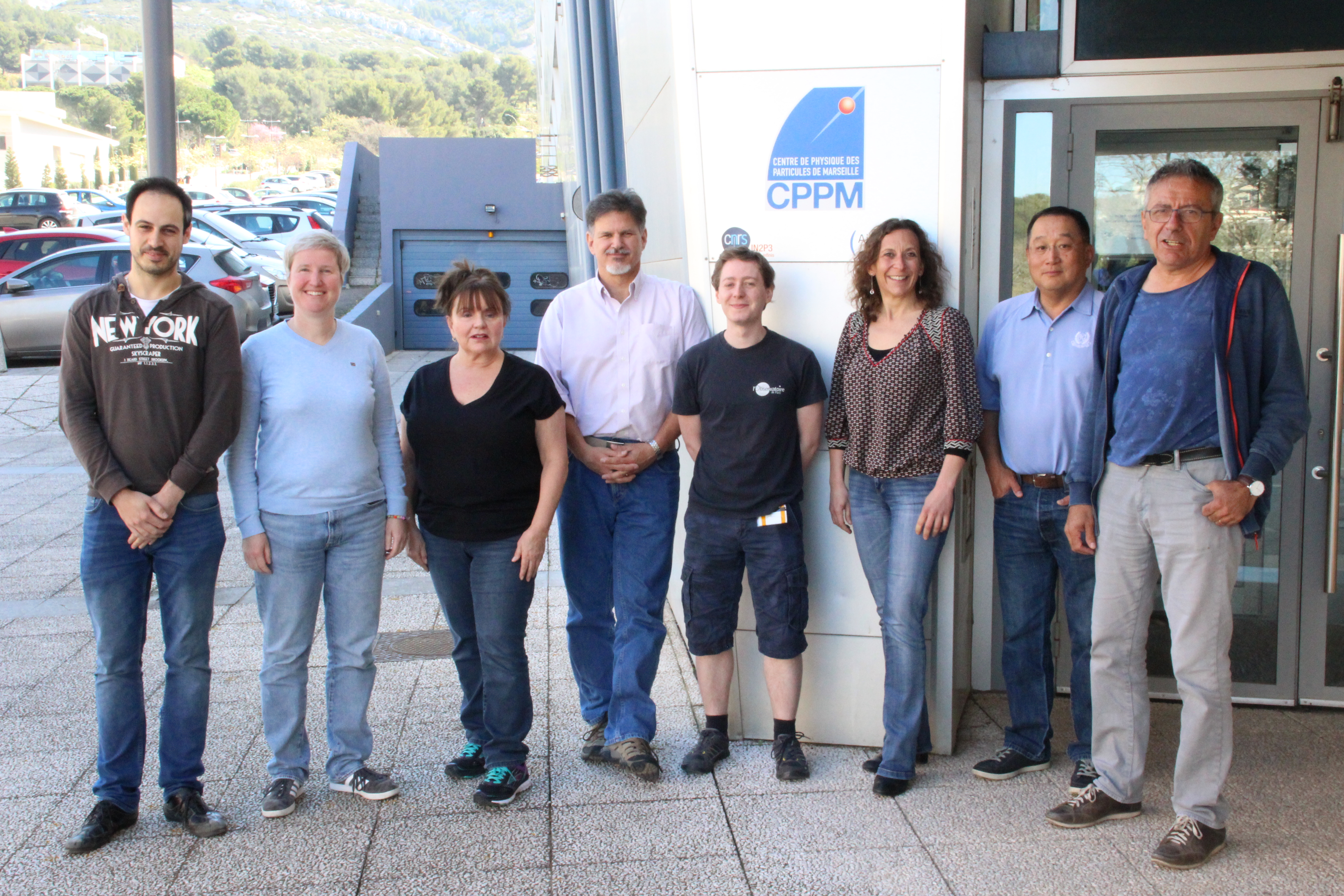
From left to right: Romain Legras1, Aurélia Secroun1, Dana 2, Allan Runkle2, Benoît Serra1, Laurence Caillat1, Hyung j. Cho2, Jean-Claude Clemens1 (1CPPM, 2NASA-JPL)
Modified 23 Jun, 2017